Anaheim and Orange County
Tile underlayment replacement in Anaheim
On a tile roof the tile is the rain screen and the layer beneath it is the waterproofing. When that layer reaches the end, the roof leaks everywhere and the tile is still fine.
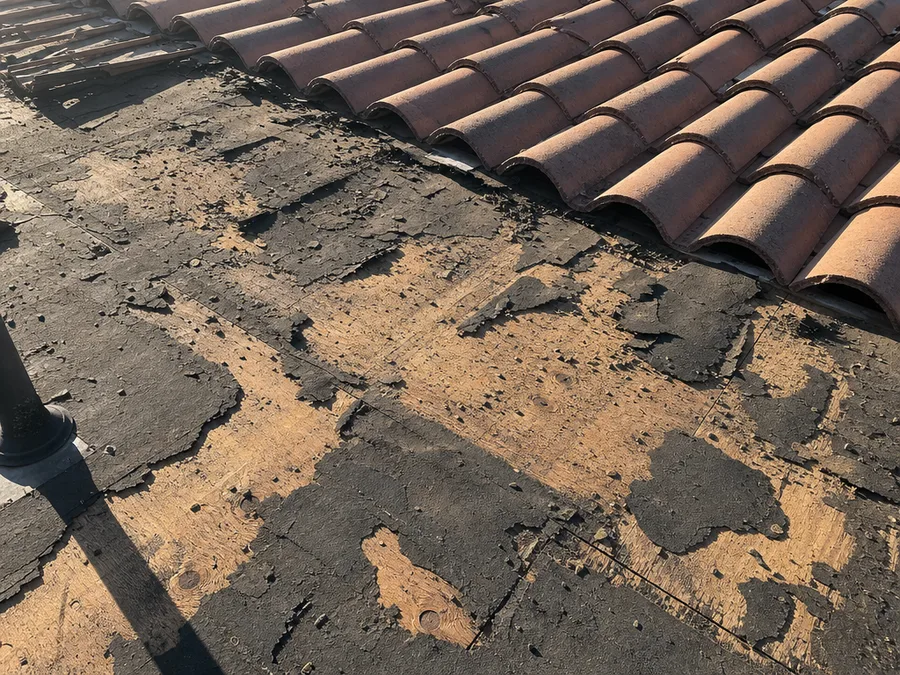
Tile underlayment replacement is the job Anaheim homeowners arrive at when the roof keeps leaking and the tile keeps turning out to be fine. It goes by several names. Underlayment replacement, a relay, or lift and relay, which is the most descriptive of the three: the tile is lifted, the layer beneath it is replaced, and the same tile is laid back down.
It is one of the larger residential roofing jobs in Southern California, and it is genuinely uncovered ground in this city. If you got here because tiles are broken rather than because the roof is leaking in new places, tile roof repair is the closer match.
Why the tile outlives the layer beneath it
A tile roof is two systems doing two jobs. The tile sheds the bulk of the water, breaks the sun, and takes the wind. Underneath it, fastened to the deck, is a continuous membrane that catches everything the tile does not: wind driven rain, water that runs backwards up a lap, condensation, and whatever gets past the ridge.
That membrane is the waterproofing. It is also the part with the shorter life, because it is organic or bituminous in most older assemblies, it runs hot under a dark tile in summer, and it is the only part of the roof nobody ever looks at.
So the ordinary end state of a tile roof in this region is a covering with decades left sitting on a water layer that has run out. The leaks that follow have a characteristic pattern: they appear in new places, each repair works, and the next one shows up somewhere else. That pattern is the diagnosis.
What the underlayment actually is, and which types the code allows
This is the section the rest of the market does not write, and it is the one that makes a quote readable.
The residential code's own table sets out which underlayment types may be used under clay and concrete tile. It permits ASTM D226 Type II, the heavier of the two traditional asphalt saturated felts, along with ASTM D1970, which is a self adhering membrane, and ASTM D8257. It also permits ASTM D2626 and ASTM D6380 Class M for tile specifically.
Two things follow from that list, and both are practical.
First, felt and membrane are not the same product and are not priced the same way. A quote saying only underlayment has told you nothing. A quote saying ASTM D226 Type II or ASTM D1970 has told you exactly what is going on your roof, and you can look up what those mean.
Second, the code is a floor and the tile manufacturer's instructions sit on top of it. The code says tile is applied in accordance with the chapter and the manufacturer's installation instructions, based on climate, roof slope, the underlayment system and the type of tile. So the specification is a combination of three documents rather than one, which is why a real specification names the tile as well as the membrane.
Batten systems, and the part of this the code hands to the manufacturer
Battens are the strips a tile can be hung on rather than laid directly to the deck, and they come up on a relay because they are the part most likely to be replaced with the underlayment.
Here the honest answer is that the residential code does not specify batten practice for tile in detail. It sets the sheathing requirement, requiring tile to be installed over wood structural panels or solid lumber sheathing, it sets the slope and underlayment rules, and then it defers the application itself to the tile manufacturer's instructions and to the evaluation report for that product. That is not a gap in the code, it is the code pointing at the document that actually governs.
Which means: on a relay, ask what the batten arrangement is going back as, and ask whether that arrangement is what the tile's own evaluation report specifies. The Tile Roofing Industry Alliance publishes trade resources on this, and the ICC-ES evaluation report listing is where the report for a specific tile is published. The City's permit application asks for that report number on tile roofs anyway, so it exists for your roof whether or not anyone mentions it.
Roof slope changes what the underlayment has to be
This one is worth more than anything else on the page, because it decides the specification and almost nobody asks about it.
Clay and concrete tile requires a minimum slope of two and a half units vertical in twelve horizontal. Below that, tile is not the covering. And between two and a half and four in twelve, the code requires a double underlayment application rather than a single one.
That band matters a great deal here, because a very large number of Anaheim houses have a lower pitched section: an addition off the back, a patio roof, a section over a garage, a wing added in a different decade. If part of your roof sits in that band, part of your relay is a double application and part of it is not, and a quote that prices the whole roof as one thing has either allowed for that or has not.
Ask the question directly. What is the pitch of each plane, and which of them take a double underlayment application.
What a relay involves, in order
The sequence is what makes this job different from a reroof, and it is why it takes longer than the same area of shingle.
The tile comes off in sections and is stacked on the roof rather than carried down, because handling it twice is what breaks it. The old underlayment is stripped back to the deck, and the deck is inspected properly for the first time since the house was built. Any damaged sheathing is replaced, which is also the moment the City requires the sheathing size and thickness to be stated where there is a tear off.
New underlayment goes down, along with new flashings, valley metal and edge metal, which is the part that quietly makes or breaks the result. Reusing thirty year old valley metal under a new water layer is false economy that shows up in about four winters.
Then the tile goes back, fastened to the current requirements rather than to whatever was normal when the house was built, and broken pans are replaced from the stack or from matched stock.
Working section by section is deliberate. It keeps the roof coverable overnight, which matters if the job runs into the wet months at all.
What a lift and relay costs, and how to compare two quotes
We do not price this work and any number produced here would be fictional. What is worth saying is what the price is made of, because this is a job where two quotes can differ by a lot for legitimate reasons.
The four variables are the roof area in squares, the pitch and the number of planes, the expected tile breakage and what happens to it, and how much sheathing is replaced. Ask for all four as separate lines. Ask specifically what percentage of tile breakage is allowed for and what happens if the real figure is higher, because on an old clay profile that is the number with the most risk in it.
One more distinction worth understanding, because the words get used loosely. Material warranties come from the manufacturer of the membrane or the tile and are written by them. Workmanship warranties come from the contractor doing the work and are a separate promise from a different party. They cover different failures, they last different lengths of time, and a quote that offers a single warranty figure has combined two things that are not the same. This site does not warrant anybody's work and does not offer a warranty of its own, so get both in writing from whoever you hire.
Where a relay meets the 50 percent rule
A relay replaces the water layer across most or all of the roof, which means it is comfortably over the threshold that pulls in the current requirements.
California's residential code applies the current fire classification to the entire roof covering where more than 50 percent of the total roof area is replaced within any one year period, with Class C as the floor outside the designated wildfire areas. The Title 24 cool roof requirement turns on a similar share of the roof surface. Neither is a reason not to do the work, and both are reasons to have the conversation before the tile comes off rather than after.
Anaheim enforces the 2025 California building standards codes for projects submitted from the start of 2026, published on the City's current building codes page. The permit path itself, including the plan check that applies above six pounds per square foot and the two inspections the City requests, is set out on the Anaheim roofing permits page.
Two last pointers. If the roof carries solar, the array has to come off and go back on, and that changes the sequence: see reroofing under existing panels. And if you are still deciding whether the roof needs this at all, repair or replace works through the comparison, while roof replacement covers the case where the tile is going too.
| What it governs | The figure | Published by |
|---|---|---|
| Underlayment standards permitted under clay and concrete tile | D226 II, D1970, D8257 | 2025 California Residential Code Table R905.1.1(1) |
| Two further types the same table permits under tile | D2626, D6380 Class M | 2025 California Residential Code Table R905.1.1(1) |
| Slope band requiring a double underlayment application | 2.5 to 4 in 12 | 2025 California Residential Code R905.3.3 |
| Sheathing tile must be laid over | Panels or solid lumber | 2025 California Residential Code R905.3.1 |
What people ask before a relay
How do you replace the underlayment on a tile roof?
The tile comes off in sections and is stacked on the roof rather than sent down, the old water layer is stripped back to the deck, the sheathing is inspected and repaired, new underlayment goes down with new flashings and metal, and the same tile is set back. Working in sections is what keeps the roof coverable overnight.
What type of underlayment is best for a tile roof?
There is no single answer, and anyone who gives you one without asking about your roof is selling rather than specifying. The code permits several types under tile, the slope decides whether a single or double application is required, and the tile manufacturer's own instructions sit on top of both. Ask for the ASTM designation in writing, not a brand name.
How often should I replace underlayment on a tile roof?
Not on a schedule, on evidence. The signals are leaks appearing in new places on a roof whose tile is sound, previous repairs that held individually while the problem kept moving, and an underlayment that was chosen by whoever built the house rather than by anybody since.
Do I have to buy new tile as well?
Usually not, and that is the entire point of a relay. Expect breakage of some percentage of the tile during handling, which a quote should state up front, and expect to source replacements for that percentage. If your profile is out of production, that number is the one to negotiate hardest about.
How much does it cost to replace the underlayment on a tile roof?
It is priced per square of roof area and it varies with pitch, the number of planes, how much tile survives handling and how much sheathing has to be replaced. Get the quote itemised into those four things, because a single lump sum for a job this size hides exactly the variables that will change it later.
Ask what is left under your tile
The age of the house, the tile profile if you know it, and where the leaks have appeared. A roofing contractor working in Anaheim uses those three things to say whether a relay is the job.