Anaheim and Orange County
Tile roof repair in Anaheim
Tile is the covering most Anaheim roofs wear, and it outlasts almost everything beneath it. That is why a tile repair so often turns out to be a question about the layer underneath.
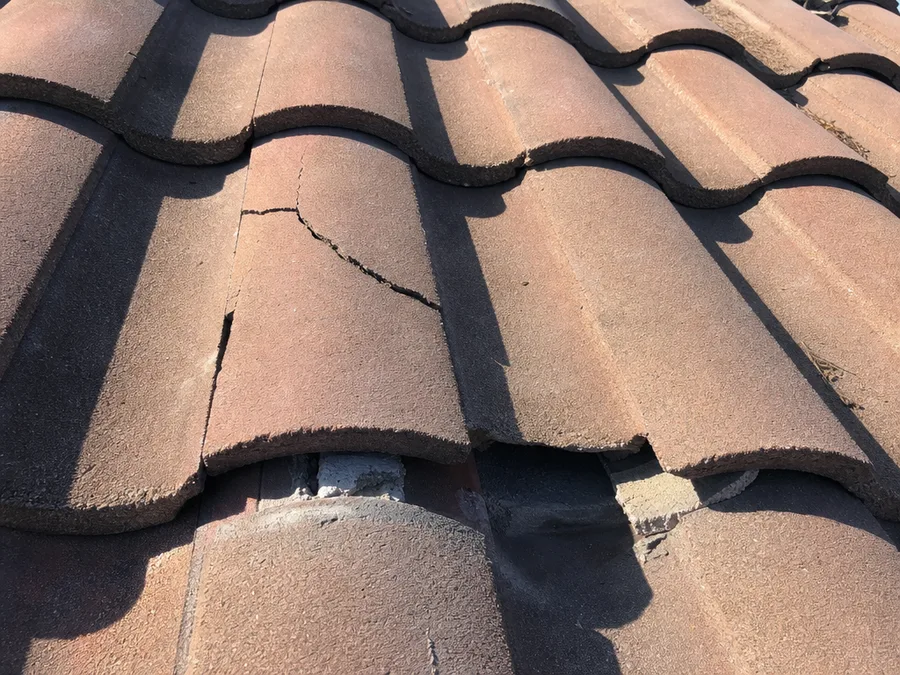
Tile roof repair in Anaheim is a different trade from repairing a shingle roof, and the difference is not cosmetic. Tile is heavy, it is brittle, it sits proud of the deck on a system of its own, and it lasts long enough that the roof around it usually fails first. Almost every useful decision about a tile roof follows from that one fact.
Most houses here wear concrete or clay tile, which is why the covering is worth understanding in its own terms rather than as a variant of something else. If the whole covering has reached the end, roof replacement is the page for that.
Slipped, cracked and broken tiles on an Anaheim roof
Three things go wrong with tile, and they have different causes and different fixes.
Broken pans. A tile has cracked or lost a corner. Causes: something fell on it, somebody stood on it, or a fixing was over driven when the roof was laid and the tile has been under stress ever since. This is the small repair, and it stays small if it is dealt with before the exposed underlayment starts to go.
Slipped tiles. A tile has moved down the slope out of its course. That means whatever was holding it is no longer holding it, which is either the fastener, the batten it was hung on, or the tile's own nose where it hooked. One slipped tile is an incident. Several in a line is a fastening problem, and several in different places is a systems problem.
Ridge and hip movement. The tiles along the top of the roof and along the hips are bedded rather than simply hung, and the bedding is the part that fails. This shows as a ridge line that has gone wavy, or as gaps that were not there before.
Concrete tile and clay tile are not the same repair
Both are permitted by the same code section and both are laid in similar ways, and after that they behave differently enough to matter.
Clay is fired and holds its colour permanently, because the colour is the material. It is more brittle than concrete and less forgiving of a misplaced foot, and older clay profiles are the ones most likely to be out of production, which turns a two tile repair into a hunt for salvage.
Concrete is cheaper, heavier in most profiles, and its colour is a surface treatment that fades with sun exposure. That matters for repairs in a way nothing else does: a new concrete tile put into a thirty year old roof will be visibly the wrong shade for years even if it is the identical product. Anybody who has matched tile in this city knows to take replacements from a less visible slope and put the new ones there instead.
The code recognises both explicitly, requiring clay tile to comply with ASTM C1167 and concrete tile with ASTM C1492. A quote that names the standard as well as the product is a quote written by somebody who has read the chapter.
Why walking a tile roof breaks more tiles
This is the most useful practical thing on this page, and it is why a tile repair costs what it does.
Tile spans between its supports. Weight applied in the middle of a pan, rather than at the head where it is supported, cracks it. Somebody who does not know tile will come off a tile roof having broken more of it than the original problem, and the breakages will not be obvious until the next winter when the underlayment beneath them has been sitting in the sun.
That is also why satellite installers, solar crews, painters and gutter cleaners are a common cause of tile damage. If somebody has been on your roof for a reason unrelated to roofing, and a leak appeared afterwards, those two facts are usually connected.
It follows that walking a tile roof is a cost, not a free inspection. Fewer trips up is better, which is an argument for having someone look at everything at once rather than calling somebody out three times in a season.
Moss, algae and debris buildup
Anaheim is dry, so this is a smaller problem here than it is on the coast or in the north, but it is not nothing. Anything that holds moisture against tile keeps it wet for longer than the climate would.
Buildup collects in valleys, behind chimneys, under overhanging trees and along the low edge of any slope that faces away from the sun. What it does is hold water in contact with the underlayment, and on a tile roof the underlayment is the waterproof layer. The tile is a rain screen.
Cleaning it off is worth doing and pressure washing it off is not. High pressure drives water up under the courses, past the laps that were designed to shed it downhill, and strips the surface of concrete tile at the same time. The Tile Roofing Industry Alliance publishes resources on tile roofing practice which are written for the trade rather than for homeowners and are worth a look if you want to see what good practice actually says.
When a tile repair is really an underlayment job
Here is the pattern that decides it. If leaks keep appearing in new places on the same roof, and each one is fixed successfully, and the next one appears anyway, the tile is not the problem. The layer under it has reached the end of its life and water is getting past it wherever it happens to find a way.
That is the point at which repeated repairs stop being economical, and the job becomes a tile underlayment replacement: the tile is lifted and stacked, the water layer is replaced, and the same tile goes back down. It is a large job and it is very often the right one, because the tile is the expensive part and it is still perfectly good.
The ages that matter, roughly: original underlayment on a Southern California tile roof is not a lifetime material, and the tile above it is. If your roof is old enough that the underlayment was chosen by whoever built the house, that is the calculation you are in.
Attic ventilation, and why it belongs on this page
Tile roofs breathe differently from shingle roofs because of the air gap the profile creates, and the attic underneath is still part of the assembly. A poorly ventilated attic runs hot and holds humidity, and both shorten the life of the layer directly above it.
If a tile roof is being opened up for any reason, that is the moment to look at the vents, because it is the only time they are easy to reach. This is not upselling, it is sequencing: the same work done separately later costs the access twice.
The rules a tile repair has to respect
Tile is one of the few coverings with genuinely specific requirements in the residential code, and knowing them makes a quote much easier to read.
Tile requires a minimum slope of two and a half units vertical in twelve horizontal, which the code describes as a 25 percent slope. That is worth remembering, because it is the only place the number 25 appears anywhere in the roofing chapter, and it is the origin of a great deal of confusion about a supposed 25 percent rule. There is no such rule, and the Anaheim roofing permits page sets out what the real threshold is.
Between two and a half and four in twelve, a double underlayment application is required. Fasteners have to be corrosion resistant, not less than 11 gauge, and long enough to penetrate the deck by three quarters of an inch or through its full thickness. Tiles weighing under nine pounds per square foot take at least one fastener each regardless of slope, and there is a defined perimeter zone at hips, ridges, eaves and rakes where fastening is heavier.
Which edition of the code applies to your job is worth checking rather than assuming, and the City publishes what it currently enforces on its building codes page. If a permit is involved, the application also asks for an ICC-ES evaluation report number for tile roofs, published in a public listing.
Where a tile roof has had several repairs and keeps producing new ones, the question stops being about the tile at all. Repair or replace an Anaheim roof covers how to tell which of the three possible jobs on a tile roof you are actually looking at.
| What it governs | The figure | Published by |
|---|---|---|
| Minimum slope for clay and concrete tile | 2.5 in 12 | 2025 California Residential Code R905.3.2 |
| Slope range that requires a double underlayment application | 2.5 to 4 in 12 | 2025 California Residential Code R905.3.3 |
| Minimum nail gauge for tile fastening | 11 gauge | 2025 California Residential Code R905.3.7 |
| Depth a tile fastener must reach into the deck | 0.75 in | 2025 California Residential Code R905.3.7 |
| Weight below which every tile takes at least one fastener regardless of slope | Under 9 lb per sq ft | 2025 California Residential Code R905.3.8 |
Questions about tile roofs in this city
Can you repair a tile roof?
Yes, and far more often than people expect. Tile is a hard covering that breaks locally rather than wearing out evenly, so single broken pans, a slipped course and damaged ridge can all be put right without touching the rest of the roof, provided the profile can still be matched.
How much is it to repair roof tiles?
A handful of broken pans is a small job and a slipped course over a valley is not, which is why the quote should say how many tiles, whether any are being sourced to match, and whether the underlayment beneath them is being opened up. Those three lines explain almost all of the difference between two prices.
What is the average lifespan of a tile roof in California?
The tile itself commonly outlasts the house it was put on, and manufacturers publish long service lives for concrete and clay alike. The layer under it does not, which is the single most useful thing to know about owning one of these roofs, and it is covered on the underlayment page.
Do broken tiles mean the roof is leaking?
Not necessarily, and that is why a broken tile is worth fixing before winter rather than after. The underlayment beneath is the waterproof layer, so a cracked pan exposes it to sun and foot traffic long before it lets water into the house, and the damage that follows is to the layer you cannot see.
What is the average cost of a tile roof replacement?
Ask what is actually being replaced before you compare any two figures, because a tile roof replacement can mean new tile throughout, or the existing tile lifted and set back over a new water layer. Those are very different jobs at very different prices, and they are frequently quoted under the same words.
Send a photo of the broken course
One close photograph and one from further back. The profile, the colour and how many courses are affected are what a roofing contractor working in Anaheim needs to price it.