Anaheim and Orange County
Flat roof repair in Anaheim
Almost no house here is entirely flat, and almost every house here has a flat part. It fails on its own schedule, at its own details, and it needs a different repair.
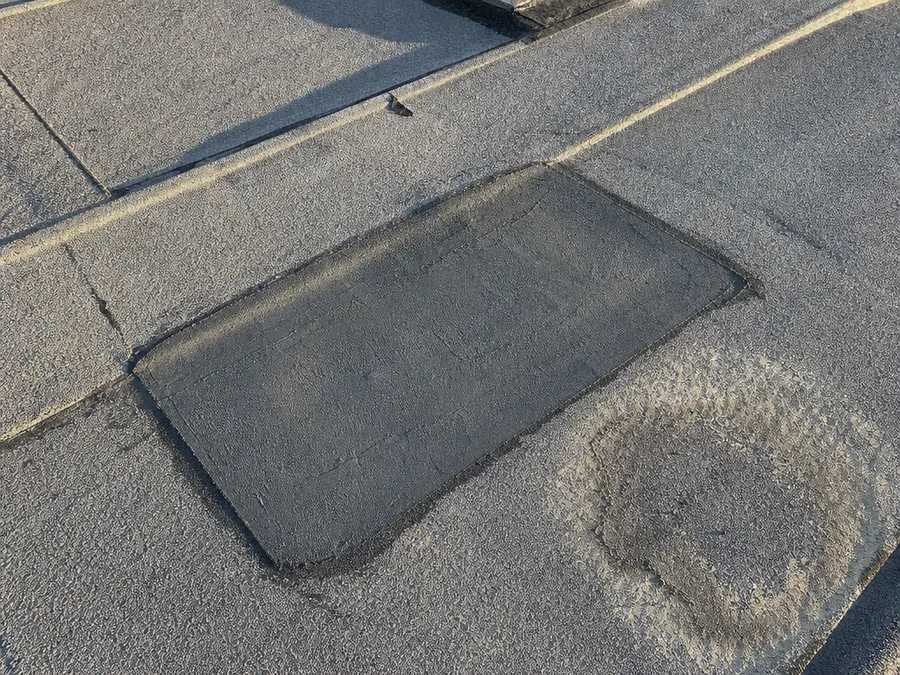
Flat roof repair in Anaheim is mostly not about flat roofs. It is about the low-slope sections that pitched houses have: the addition off the back, the run over a garage, the deck above a room, the patio cover, the section behind a parapet at the front. Those parts fail on a different schedule from the tile or shingle around them, and they need a different repair.
If the problem is on the pitched part of the roof, roof repair is the general page and roof leak repair is the diagnostic one.
Where a low-slope roof actually fails
A flat roof is a continuous membrane, which means it has very few places where water can get in, and all of them are places where the membrane is interrupted.
Seams and laps. Where two sheets meet. Older seams open as the membrane hardens and contracts, and a seam that has begun to lift will do it along its whole length rather than in one spot.
Flashings and terminations. Where the membrane turns up a parapet, meets a wall, or stops at an edge. This is the largest single category, and the failure is usually at the top of the upstand where the termination is, not at the bottom where people look.
Penetrations. Vent pipes, condenser stands, drains and anything mounted on the roof. Each one is a hole with a collar around it and the collar is a wear item.
Drains and scuppers. Blocked, undersized, or set slightly too high. Water that does not leave has to go somewhere.
Blisters and splits. Trapped moisture that expands in the heat, or a membrane that has lost enough flexibility to tear at a stress point. Both are signs about the age of the whole surface rather than about one spot.
Ponding, and why drying out is not the fix
Water that stands on a low-slope roof for more than a couple of days after rain is doing damage the whole time it is there.
It is heavy. Water weighs roughly 62 pounds per cubic foot, so an inch of standing water is a little over five pounds on every square foot it covers, which is a real load on a structure that was designed for a roof that drains. It ages most membranes faster than sun does. It concentrates dirt and organic material, which holds it there longer. And it finds every seam it happens to be sitting on top of.
Anaheim's rainfall is concentrated into a few winter months, which fools people about this: the pond appears in January and is gone by April, so it does not feel like a permanent problem. It is a permanent problem that is only visible for part of the year.
The fix is drainage rather than surface. Sometimes that is clearing a drain and cutting a scupper properly. Sometimes it is tapered insulation to build a fall towards the outlet. What it is not is another coat of something over the top, because the pond will sit on that too.
Coatings: what they do, and what they cannot do
Roof coatings are a legitimate product and they are also the most oversold thing in low-slope roofing, so it is worth being precise.
A coating is a liquid applied surface that goes over an existing membrane. What it genuinely does: it restores a weathering surface, it can bridge small cracks and reinforce seams when it is applied with fabric, it reflects heat, and on a sound roof with a real fall it can add years for a fraction of the cost of replacement.
What it cannot do: fix a roof with water trapped inside the assembly, add a slope that is not there, replace a termination that has failed, or make a brittle membrane flexible again. A coating applied over trapped moisture seals the moisture in and the blisters come back through it.
The test is the condition of what is underneath. A coating is a good decision on a roof that is intact and tired, and a bad one on a roof that is failing. Anyone who recommends one without cutting a test patch or checking the assembly has recommended it before knowing.
Coatings are also where the cool roof requirement shows up on a low-slope job, because reflectance is a property of the surface. The Cool Roof Rating Council publishes a directory of rated products with the measured values for each, which is the place to check a claim rather than the brochure.
Which membrane is on your roof
Anaheim houses carry four common low-slope assemblies, and knowing which one you have changes every other answer.
The oldest of them is built-up roofing, layers of felt and bitumen with gravel on top, which is the traditional hot mopped roof. The code sets its minimum design slope at a quarter unit in twelve for drainage, and an eighth for coal-tar.
Modified bitumen is sheet material, torched or cold applied, usually with a granular surface, and it takes the same quarter in twelve minimum. It is the most common thing found on residential additions in this city.
Single-ply is a thermoset or thermoplastic sheet, mechanically fastened or adhered, with seams welded or bonded. It is lighter than the other two and usually a paler colour.
Sprayed polyurethane foam is applied in place and then coated, and the coating has to go on within a defined window after the foam rather than at some later convenience. If the coating on a foam roof has failed, the foam itself is exposed, and that is urgent rather than cosmetic.
A quote that does not name which of these it is repairing has not looked closely enough to be relied on.
The drainage rules a reroof does and does not bring in
This is the useful compliance detail on this page, and it cuts in the homeowner's favour for once.
New low-slope work has to drain, with roof drains at each low point where the roof is not sloped to drain over its edges, and secondary overflow drains or scuppers where a parapet could trap water. The code gives those overflow provisions real numbers: the overflow inlet sits two inches above the low point, and an overflow scupper has a minimum opening height of four inches.
The exception is in the reroofing section. Where a roof already provides positive drainage, recovering or replacing the covering does not require the secondary overflow drains or scuppers to be added, and reroofing is not required to meet the minimum design slope that applies to new work. In plain terms: replacing the surface on a low-slope section that drains does not automatically drag a drainage rebuild in with it.
That is worth knowing because it is a genuine reason a low-slope reroof can be cheaper than expected, and it is not something a quote is likely to volunteer.
Anaheim enforces the 2025 California building standards codes for projects submitted from the start of 2026, on the City's current building codes page, and the permit path itself is on the Anaheim roofing permits page. If the low-slope section is being replaced as part of a whole-roof job, roof replacement covers what that involves, and roof replacement cost in Anaheim covers what moves the number.
| What it governs | The figure | Published by |
|---|---|---|
| Minimum design slope for a built-up roof | 0.25 in 12 | 2025 California Residential Code R905.9.1 |
| Minimum design slope for a coal-tar built-up roof | 0.125 in 12 | 2025 California Residential Code R905.9.1 |
| Minimum design slope for modified bitumen | 0.25 in 12 | 2025 California Residential Code R905.11.1 |
| Height above the low point an overflow drain inlet sits at | 2 in | 2025 California Residential Code R903.4.1 |
| Minimum opening height of an overflow scupper | 4 in | 2025 California Residential Code R903.4.1 |
Questions about low-slope roofs
How to fix a flat roof without replacing it?
By repairing the detail that failed rather than resurfacing the field. Most low-slope leaks are at a seam, a flashing, a drain or a penetration, and all four are repairable in place on a membrane that still has flexibility left. What cannot be repaired that way is a membrane that has gone brittle across the whole area.
What is the best thing for a leaking flat roof?
Finding out what the roof is made of first. A repair that works on a modified bitumen roof can be the wrong product entirely on a single-ply membrane, and putting the wrong material over the top of the right one is the most common way a small leak becomes an expensive one.
What is the 25% rule for roofing?
It is not a rule in California. The number people are reaching for is more than 50 percent of the roof area within any one year period, which is the threshold that pulls the whole covering up to the current fire classification. The permit page sets out where that comes from.
Is ponding water always a problem?
Water that clears within a day or two of rain is normal on a low-slope roof and water that is still there a week later is not. Standing water accelerates the ageing of most membranes, adds weight, and finds any seam it is sitting on, so a persistent pond is a drainage question rather than a surface one.
How much does it cost to fix a flat roof?
The honest answer is that it depends on the membrane and the detail, and that anyone quoting before they know both is guessing. Ask for the quote to name the membrane type, the specific detail being repaired, and whether the price includes opening the assembly up to check what is underneath.
Tell us where the water sits
Which section is flat, what the surface looks like, and where water stands after rain. A roofing contractor working in Anaheim reads that and knows what to quote.