Anaheim and Orange County
Emergency roof repair in Anaheim
Wind has lifted a section, something has come through, or a slope has failed in a storm. Emergency work closes the roof so the damage stops growing, and the permanent repair follows.
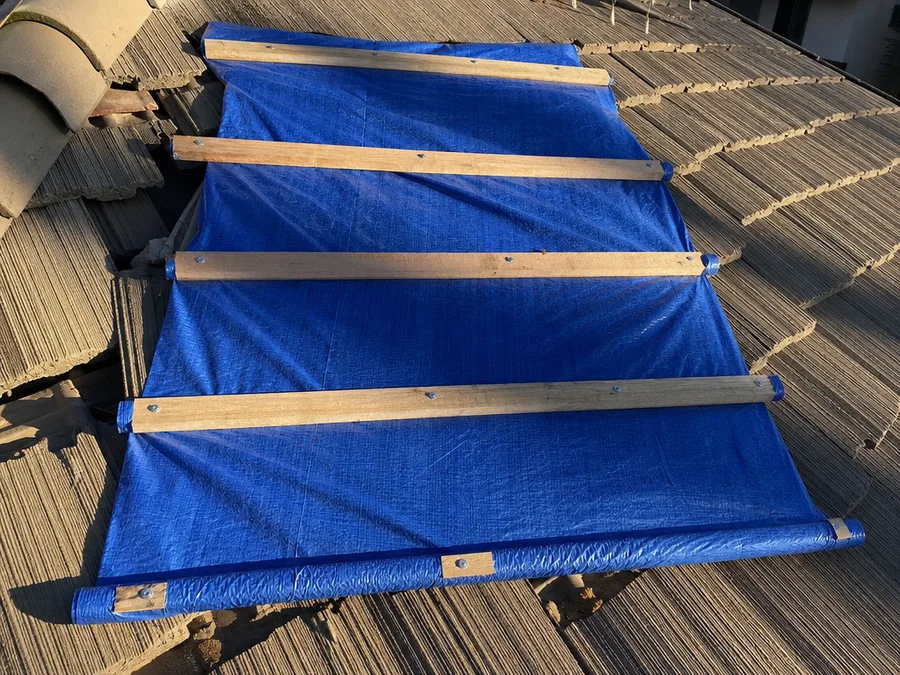
Emergency roof repair in Anaheim is a narrow job with a clear purpose: close the roof, stop the damage getting bigger, and buy enough time to do the real repair properly. It is worth understanding what that involves before you agree to anything, because this is the one roofing situation where people sign whatever is put in front of them.
Two honest notes before anything else. This site passes your request to a roofing contractor working in Anaheim and does not run a crew, so it cannot tell you when somebody will arrive. And if the roof has come down, if there is anything electrical involved, or if part of the structure looks unsafe, that is a call to the fire department and not a form on a website.
What counts as an emergency, and what can wait until Monday
The dividing line is whether the roof is open. An open roof gets worse every hour it rains and stops getting worse the moment it is covered.
Genuinely urgent: a section of covering gone and the deck exposed, a tree limb or debris through the roof, water running rather than dripping, or a slope that has visibly moved. Those need closing now.
Not urgent in the same way, even though it feels like it: a stain that has appeared on a ceiling, a drip in a rainstorm, a few tiles that have slipped on a dry day. Those are leak repairs and tile repairs, and paying emergency rates for them is money spent on the calendar rather than on the roof.
Santa Ana winds, and what they do to a roof here
Roofing advice written for other parts of the country talks about hail and about hurricanes. Neither is the hazard in Anaheim. What this city gets is Santa Ana wind, offshore and dry, running roughly October through April, which is the same half of the year that almost all of the rain arrives in. That overlap is the actual problem: wind opens the roof in one week and rain finds the opening in the next.
Wind damage to a tile roof looks different from wind damage to shingle. Wind lifts the leading edge of a tile course and slides it, and the tiles that go first are almost always at the perimeter: the eave, the rake, the ridge and the hips. That is not bad luck, it is aerodynamics, and the code recognises it directly by defining a perimeter fastening zone of three tile courses, and not less than 36 inches from either side of hips or ridges and from the edges of eaves and gable rakes.
On shingle, wind lifts tabs and creases them, and a creased tab does not lie back down. That damage is easy to miss from the ground and obvious from the roof.
Tarping and board repairs, and what a temporary fix is for
Tarping is the standard answer and doing it properly is a skill. A tarp that is simply laid over the damage and weighted with something heavy will move in the next wind and can take more covering with it. A tarp that is going to hold is run well past the damage on all sides, carried over the ridge where possible so water cannot get under the top edge, and fastened along battens rather than by punching fixings through the middle of it.
Board repairs come in when something is open rather than merely uncovered: a hole through the sheathing, a section of deck that has gone soft, a rafter that has taken a hit. Boarding closes the structure until it can be repaired properly.
Both are temporary by design. They are not meant to look neat and they are not meant to last. If either has been on the roof for months, the temporary fix has quietly become the roof, and that is a worse position than the one it was solving.
From the temporary fix to the permanent repair
The permanent repair is a normal roofing job on a normal schedule, and it is where the real decisions get made: whether the affected slope is repaired or replaced, whether the underlayment beneath it survived, and whether the damage was the cause or just the visible part of something older.
One thing worth knowing before that conversation. If the permanent work ends up replacing more than 50 percent of the total roof area within any one year period, the whole covering has to meet the current fire classification, which outside the designated wildfire areas means Class C as a floor. Storm damage repairs are exactly the kind of work that creeps over that line without anyone planning it. The Anaheim roofing permits page sets out where the threshold comes from and what the City asks for.
Anaheim enforces the 2025 California building standards codes for projects submitted from the start of 2026, which the City publishes on its current building codes page.
What you can do before anybody gets on the roof
Since we cannot tell you when somebody will arrive, here is what is actually useful in the meantime, and none of it involves a ladder.
Move what is under the leak, and put a bin under it rather than a towel. If a ceiling is bulging with trapped water, a small hole punched in the low point of the bulge from below will drain it into a bucket and is far less damaging than the ceiling coming down in one piece. Turn off power to any circuit near where water is coming in. Photograph everything, inside and out, before anything is moved or cleaned up, because that record is worth having whatever happens next.
Then write down what happened and when. Wind damage in particular is easier to describe on the day than a fortnight later, and the person quoting the repair will ask.
Who does this work, and how to check them
Roofing is licensed in California under classification C-39. Emergency work is the situation most likely to put an unfamiliar name in front of you, sometimes unprompted, and the check takes seconds: the licence number from the quote goes into the CSLB register and comes back with the status and the classification.
The CSLB also publishes guidance on hiring a contractor, including the parts about deposits and about work starting before anything is in writing. This site does not verify anyone's credentials on your behalf and does not claim to, which is precisely why the check is described here rather than promised.
Once the roof is dry and nobody is rushing, the question changes into a slower one. Whether the covering that failed in a wind is worth patching or has been telling you something for a while is worked through in repair or replace an Anaheim roof.
| What it turns on | The figure | Published by |
|---|---|---|
| Wind speed above which tile attachment follows the manufacturer's instructions rather than the table | Over 130 mph | 2025 California Residential Code R905.3.8 |
| Height above grade that triggers the same rule | Over 40 ft | 2025 California Residential Code R905.3.8 |
| Perimeter fastening zone at hips, ridges, eaves and rakes | 3 courses or 36 in | 2025 California Residential Code R905.3.7 |
What people ask with a roof open
What does emergency roof work actually do?
It closes the opening and stops the damage growing. That normally means a tarp fastened down properly, boards over anything structurally open, and clearing whatever is holding water where it should not be. It is not a repair and it is not meant to look like one.
How long does a tarp last on a roof?
A properly fastened tarp is a few weeks of protection, not a season, and it degrades faster in sun than in rain. If a tarp has been on a roof since last winter it is no longer doing the job it was put there for, and the permanent repair has become the urgent one.
Is wind damage the same as storm damage?
Not in this city. Anaheim does not get hail or hurricanes, and the damage roofs take here comes from Santa Ana winds between roughly October and April, which lift and slide covering rather than smashing it. That is why this site has no storm damage page: it would be describing weather that happens somewhere else.
Should I go up and look?
No. A wet or wind damaged roof is the specific situation where people fall, and on a tile roof you will also break more of it by walking on it than the wind did. Photograph what you can see from the ground or from a window, and leave the rest to somebody with the equipment.
How fast can somebody get here?
We will not give you a number, because we would have no way of keeping it. This site passes the request to a roofing contractor working in Anaheim and they respond directly to you. If water is actively pouring into the house, deal with the water inside while you wait, and if anything is structurally unsafe call the fire department instead.
Tell us what is exposed
What happened, which part of the roof it happened to, and whether water is already inside. A roofing contractor working in Anaheim gets the request with the photographs attached.