Anaheim and Orange County
Roof repair or replace in Anaheim
Almost nobody arrives at this question with an open mind. They arrive holding a quote for one of the two and wanting to know whether the other would have done. That is a good question and it has a fairly reliable answer.
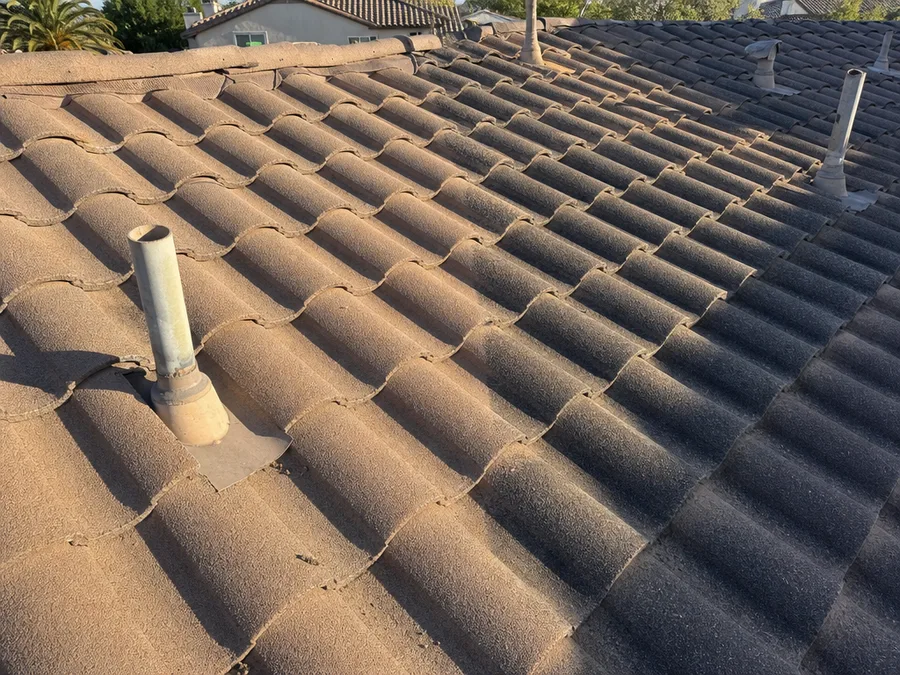
Repair or replace is a question about one thing: whether what failed is local or whether the roof has reached the end as a system. Everything else, age included, is evidence towards that question and not the answer to it.
The pattern that settles it
Each of the two answers has a signature, and it shows up in the roof's history more clearly than in the roof itself.
A repair looks like one failure with a cause you can name. Something came off in a wind, a tree took a course of tile, a flashing at a chimney opened up, a valley filled with debris and backed water under the covering. The water shows in one place, the cause is findable, and once it is dealt with the roof goes quiet.
A replacement looks like a sequence. Water shows up, somebody fixes it, and the fix holds. Then water shows up somewhere else, and that fix holds too. The individual repairs are not failures, which is exactly what makes this hard to see from inside: every one of them worked. What has happened is that the water layer has reached the end of its life across the whole roof, and each repair has been walking around behind it.
If you can put three separate repairs on three separate parts of the roof into the last few years, the roof has already told you.
Age is the weakest signal in the set
It is the first thing most people want to know and close to the last thing that should decide it.
It is a poor guide because the same number means different things depending on what is up there. Two decades is a lot for a thin builder grade shingle, ordinary for a heavier one, and early for concrete or clay tile. Installation quality moves the figure further than the material does, and on this roof in this city the ventilation, the exposure to afternoon sun and the amount of foot traffic it has taken all matter more than the year it went on.
What age is genuinely useful for is knowing which questions to ask. An old roof deserves a proper look at the deck and the flashings. It does not automatically deserve a skip outside.
On a tile roof there are three answers, not two
The standard two way framing breaks down here, and knowing why will change how you read a tile quote.
A tile roof is two systems. The tile sheds most of the water and takes the sun and the wind. Fastened to the deck beneath it is a continuous membrane that catches whatever gets past. The tile is the part you can see and the membrane is the part that keeps the house dry, and they do not wear out on the same schedule.
So the three answers are: repair the tile, replace the layer under it and set the same tile back, or replace the roof outright. The middle one is a lift and relay. It is the right answer to a large share of the leaking tile roofs in this city, and the one most likely to go unmentioned. Tile underlayment replacement covers what that job involves, and tile roof repair covers the cases where the tile itself is what went wrong.
If a quote for a tile roof says replacement, find out which of the three it means before you compare it with anything.
When repairing enough of the roof becomes replacing it
There is a threshold in the building code that turns a large repair into a different kind of job, and it catches people out because it is about area rather than about intent.
Where more than half the total roof area is replaced within any one year period, the current requirements apply to the entire roof covering rather than to the part being worked on. That is the provision this market habitually calls the 25 percent rule, and the figure in the California code is 50 percent. The Anaheim roofing permits page covers where the threshold sits and what comes with it.
The practical consequence is a planning one. Repairing forty percent of a roof this year and forty percent next year is a different proposition from doing eighty percent at once, and the difference is not the roofer's preference. It is worth raising before the work is scoped rather than after, particularly if the roof is going to need attention in stages anyway.
The code also separates a replacement, which means taking the covering off down to the deck, from a recover laid over what is already there, which is permitted only in defined conditions. Anaheim enforces the 2025 code cycle for projects submitted from the start of 2026, published on the City's current building codes page.
Timing, in a city with two weather windows
Anaheim does not get the storm season most roofing advice is written around. What it gets is Santa Ana winds from roughly October through April and atmospheric river rain from roughly December through March, and those two windows are what should drive the timing of a decision rather than a season.
A repair that is holding will usually keep holding through a dry summer. A repair that is already failing should not be asked to survive a wet January. If the honest answer is that the roof is at the end and the work is going to happen, doing it in the calm months buys an unhurried tear off and a deck that is open in dry weather, which is worth more to the outcome than any month is to the price.
What to ask before you decide
Ask what failed, specifically, and where. Find out whether the same failure has been dealt with before, and whether those earlier repairs were in the same place or scattered around the roof. The deck matters too: somebody has seen it, so ask what it looked like where it was opened up. On tile, the question is whether the tile is the problem or the layer beneath it. Then ask what the roof will need in the next two years, not only what it needs this week. That last one separates a repair worth doing from a repair that buys a few months.
Work that needs a building permit, or that is worth $1,000 or more once labour and materials are counted, has to be done by somebody holding a current state licence, and roofing sits under classification C-39. That threshold catches a reroof easily and it catches most serious repairs too. The board's guidance on which classification a job needs sets out how the classifications work, and the register is public, so the number on a quote can be checked in under a minute.
If it turns out to be the larger job, roof replacement cost in Anaheim covers how to read the quote you get back. If it turns out to be the smaller one, roof repair covers what that involves, and roof leak repair is the faster read if water is coming through now.
| What it settles | What the code says | Published by |
|---|---|---|
| What counts as replacing a roof rather than repairing one | Removal to the deck | 2025 California Residential Code R908.3 |
| When a recover over the existing covering is allowed instead | Defined conditions only | 2025 California Residential Code R908.4 |
| Slope below which clay and concrete tile is not the covering at all | Under 2.5 in 12 | 2025 California Residential Code R905.3.2 |
| Design slope a reroof need not meet where the roof already drains | 2 percent | 2025 California Residential Code R908.1 |
What people ask while they are deciding
What are five signs that my roof needs to be replaced?
Leaks turning up in new places rather than the same one. Repairs that each worked and did not stop the next. Sagging, or a soft feel underfoot, which points at the deck and not the covering. Granules collecting at the downspout on a shingle roof, or daylight visible through the sheathing from inside. And a covering that has already been repaired in more places than it has left untouched. One of those is a repair conversation. Three at once is not.
What are the disadvantages of tile roofs?
Weight is the first, and it is why the City calls for an engineered plan check where a proposed roof reaches six pounds per square foot or more. Brittleness is the second, so foot traffic breaks pans and every trade that goes up there costs you tile. The third is the one that surprises people, which is that the tile is not the waterproofing at all, so a tile roof can look perfect and be leaking, and the repair is underneath rather than on top.
Do tile roofs last longer than shingles?
The tile does, comfortably, and that is not the useful comparison. What decides when either roof needs work is the membrane fastened to the deck below the covering, and on both kinds of roof that membrane has a shorter life than the tile above it. On a shingle roof the covering and the water layer tend to reach the end at roughly the same time, which is why a shingle roof is usually replaced whole. On a tile roof they do not, which is why it usually is not.
How often should a tile roof be replaced?
Far less often than the roof needs work. Concrete and clay tile are frequently still serviceable when the house changes hands twice, and the question that actually recurs is when the layer beneath them is replaced. If somebody has quoted you for new tile throughout, ask what is wrong with the tile you have, and expect a specific answer about the profile, the breakage rate or the fixings, not one about age.
Does a 20 year old roof need to be replaced?
Not on that basis. Twenty years is old for a builder grade shingle roof, unremarkable for a good one and young for tile, so the number tells you which questions to ask rather than what to do. Look instead at whether failures are recurring in different places, whether the deck feels sound, and how many repairs it has already had behind it. A roof with none of those is a roof with life left, whatever its birthday.
How to tell if a tile roof needs to be replaced?
Start by asking whether the tile is what failed. Broken and slipped pans are a repair and are covered on the tile roof repair page. Water arriving in several places under sound tile is the layer underneath, and the job is a lift and relay rather than a new roof, which the underlayment page sets out. A true tile replacement is for a profile that has become unobtainable, a roof with breakage beyond what a relay can absorb, or a deck that is coming apart anyway.
Not sure which of the two you are looking at
Describe what the roof has been doing and how long it has been doing it. The request goes to a roofing contractor working in Anaheim, and the answer you want back is which of the two jobs this is and why.