Anaheim and Orange County
Reroofing a house that already has solar on it
The array comes off, the roof gets built, the array goes back. It is a roofing job with an extra trade in the middle, and the sequencing is where the money and the risk sit.
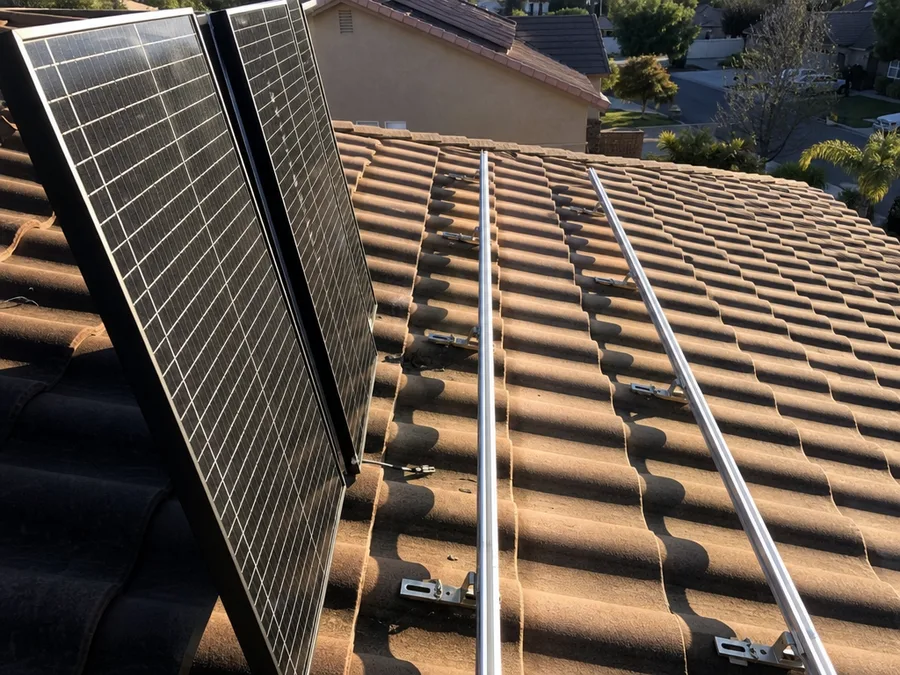
Anaheim homeowners hit this in one of two ways. Either the roof has reached the end and there is an array sitting on it, or a solar quote has come back saying the roof should be dealt with first. Both lead to the same job: roof replacement with solar panels already installed, which is a reroof plus a removal and a reset.
This page is about the roofing half. It is not a solar page, it does not sell panels, and it has nothing to say about which array you should buy.
Remove, store, reset: the sequence a reroof gains
The order matters more here than on any other roofing job, because two trades have to hand the roof to each other twice.
- Disconnect and remove. The system is shut down and isolated properly, then the panels come off their rails and the rails come off the mounting feet.
- Take up the feet. The mounts are fastened through the covering into rafters or blocking, and every one of them is a penetration that was flashed when the array went in. They come out with the covering.
- Store the array. On site if there is somewhere safe and flat, off site if there is not. Panels are glass and they are damaged by stacking them badly far more often than by anything that happens on the roof.
- Build the roof. Tear off, deck inspection and repair, underlayment, flashings, covering. A normal reroof, with the whole roof plane accessible for the first time since the array went up.
- Reset and recommission. New mounts, newly flashed into the new covering, rails, panels, reconnection and a check that the system is producing.
Step five is the one to watch. New mounts flashed into a new covering is the correct outcome. Reusing old flashing components in a new roof is where this job leaks two years later, and it is not something you can see once the panels are back on.
Who does which half, and how to check them
California licenses these as different classifications. Roofing is C-39 and solar is C-46, both on the Contractors State License Board's published list of classifications. Some businesses hold both, many hold one and subcontract the other.
Either arrangement can work. What does not work is nobody owning the interface. Before the covering comes off, get in writing who is removing the array, who is storing it, who is resetting it, who flashes the new penetrations, and who is responsible if a panel is damaged in between. That last one is the question people forget and remember later.
Both licence numbers can be checked on the CSLB register in the time it takes to type them, and the process is described on our roof inspection page. This site does not verify anybody's licence for you.
What the code says about panels on a roof
This is the part that is genuinely about roofing rather than about electricity, and it is not covered anywhere else in this market.
The residential code treats a rooftop-mounted photovoltaic system as something installed on or above the roof covering, and requires it to be tested, listed and identified with a fire classification in accordance with UL 2703, and installed in accordance with the manufacturer's instructions and its listing. Building-integrated photovoltaic products, where the panel is the covering rather than sitting on one, are tested to UL 7103 instead.
There is also a proximity rule worth knowing on a narrow lot: a Class A, B or C product is required where the edge of the roof is less than three feet from a lot line. Plenty of Anaheim lots are that narrow at one side.
None of this is exotic and none of it is optional, and the practical use of knowing it is that it gives you a question to ask: what is the fire classification of the assembly once the array is back on it. Anaheim enforces the 2025 California building standards codes for projects submitted from the start of 2026, on the City's current building codes page.
Timing: doing it once instead of twice
The removal and reset is a fixed cost that arrives whenever the roof is replaced. So the only real question is whether you pay it once or twice.
If the covering has most of its life left, install the array and reroof later. If it is near the end, reroof first and mount the array on a new roof, which is also the version where the mounting penetrations get flashed into fresh material by the people who just laid it. If it is somewhere in the middle, that is the case worth getting an inspection for, because the honest answer depends on the roof rather than on a rule.
A tile roof adds a wrinkle here. If the tile is sound and the layer beneath it has failed, the job may be a tile underlayment replacement rather than a full replacement, and the array still has to come off for it. Same sequence, different roofing work in the middle.
| What it governs | The figure | Published by |
|---|---|---|
| Standard a rooftop-mounted panel system is tested and identified to | UL 2703 | 2025 California Residential Code R902.4 |
| Standard for a building-integrated photovoltaic roof covering | UL 7103 | 2025 California Residential Code R902.3 |
| Distance from a lot line inside which a fire classification is required | Under 3 ft | 2025 California Residential Code R902.3 |
| Classification California licenses roofing work under | C-39 | CSLB, licensing classifications |
| Classification California licenses solar work under | C-46 | CSLB, licensing classifications |
What this site does: it takes your description of the job and passes it to a roofing contractor working in Anaheim, who replies to you directly with a written quote. It does not install solar, does not remove panels, and does not employ anybody who does. If the roof itself is the question rather than the array, roof replacement and the home page cover how the rest of it works, and what moves a reroof price in Anaheim covers the arithmetic.
Questions about reroofing under an array
Do the panels have to come off to replace the roof?
For a tear off, yes. The covering underneath cannot be removed and replaced with an array standing on it, and the mounting feet are fastened through the covering into the structure, so they are part of what has to be taken apart. The panels come off, get stored, and go back on the finished roof.
Who removes the panels, the roofer or the solar company?
They are separate licence classifications in California: roofing is C-39 and solar is C-46, on the CSLB's published list. Some businesses hold both. What matters for you is that the two halves are coordinated by somebody, in writing, before the covering comes off, because the gap between two trades is where this job goes wrong.
Will the panels go back exactly where they were?
Usually, and it is worth confirming rather than assuming. The array was laid out for the roof planes it is on, so the layout normally returns unchanged, but new penetrations have to be flashed into a new covering and any repositioning is a conversation to have before the panels come down rather than after.
Should I replace the roof before installing solar?
If the covering is more than about two thirds of the way through its service life, yes, and the reason is arithmetic rather than sales. A new array is a long commitment mounted on top of the covering, and reroofing later means paying for a removal and reset that could have been avoided entirely by doing the roof first.
What does the removal and reset add to a reroof?
It is quoted separately from the roofing and it is a real line item covering the disconnection, the removal, the storage, the reinstallation, the reconnection and the recommissioning. Ask for it as its own figure rather than folded into the roof price, so you can see what each half of the job costs.
Roof first, or panels first?
Tell us the age of the covering and whether the array is already up. A roofing contractor working in Anaheim can tell you which order costs less over the life of both.