Anaheim and Orange County
Roof replacement cost in Anaheim
There is no honest way to price your roof from a web page, and pretending otherwise is most of what is wrong with this search result. What a page can do is show you what the number is made of and hand you the arithmetic to compare two quotes properly.
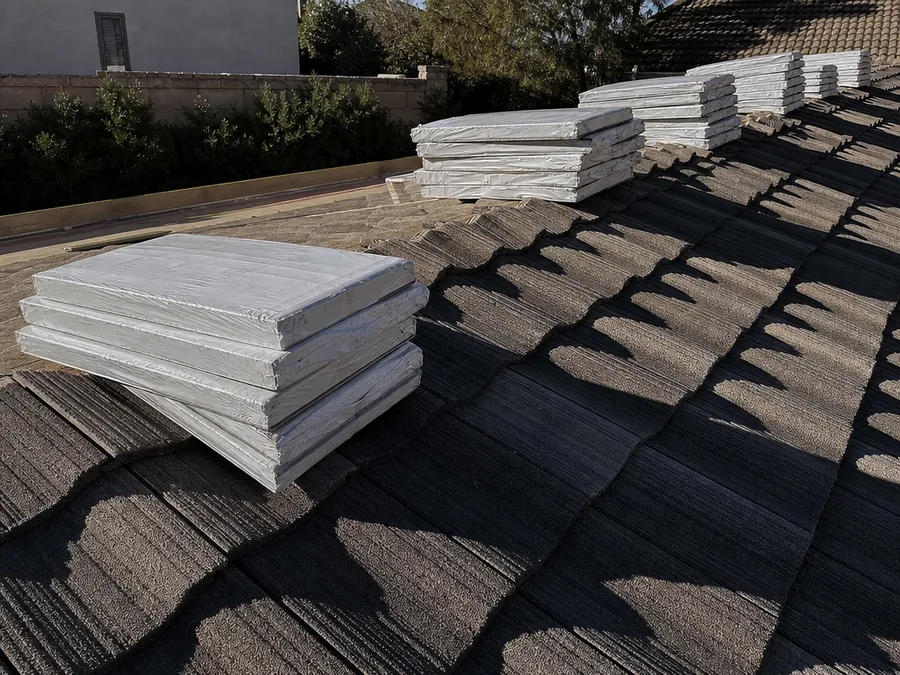
Roof replacement cost is the most searched question in this trade and the least well answered, because the honest answer to a stranger is that nobody can price your roof without measuring it. What follows is not a price. It is the structure underneath one: the unit the work is sold in, the arithmetic that makes two quotes comparable, the things in an Anaheim reroof that move the figure most, and the handful of numbers California does fix in law.
Every figure on this page names who published it. This site does not do roofing work, has no completed jobs and no crew, and quoting a price would therefore be inventing one.
Why nobody can price a roof from the size of the house
The question almost always arrives as a house size. A 1,500 square foot house, a 2,000 square foot house, a 4,000 square foot house. It is a reasonable thing to ask and it has no answer, because the roof is not the house.
Pitch is the first reason. A steeper roof covers the same footprint with more surface, and past a certain slope it also stops being walkable, which changes how the work is done and how long it takes. Plan shape is the second. A simple gable over a rectangle is close to the footprint; the same footprint broken into a main house, a wing, a garage and a patio cover has more planes, more valleys, more edges and more flashing, and every one of those is labour that a flat number per square foot does not see.
Roof replacement covers how far footprint and roof area come apart on an ordinary house here. The point for this page is simpler: until somebody has converted your roof into squares, there is no number to discuss.
Squares, and why the City uses them too
A square is one hundred square feet of roof surface. It is the unit the trade prices in, and it is not jargon invented to confuse you. It is also the unit the City of Anaheim asks for on its permit application, which lists the material and the total number of squares at one hundred square feet each.
That is worth knowing before you read a single quote, because it means the measurement is not a private convention between you and one contractor. It is the same figure that goes on a public form, and it is the figure two quotes have to agree on before anything else about them can be compared.
Most Anaheim houses land somewhere between fifteen and thirty five squares. That range is wide on purpose. Whether yours is at the bottom or the top of it depends on the pitch and the plan, and a roofer standing on the drive can usually tell you within a square or two before doing anything else.
The one piece of arithmetic that makes two quotes comparable
The method takes about ten seconds and it is the most useful thing on this page.
Take the total on the quote. Take the number of squares the quote says it covers. Divide the first by the second. That gives you a cost per square, and a cost per square is a number that means something when you put it beside another one.
If the quote does not state the squares, that is the first thing to ask for, and the answer tells you something either way. A contractor who has measured the roof can give it immediately. A figure produced without a measurement is an opening position rather than a quote.
Two warnings about the division, because it is easy to do it and still be misled.
The first is that the two quotes have to cover the same work. A per square figure that includes a full tear off, new sheathing where it is needed and new valley metal is not comparable to one that assumes the deck is sound and reuses the metal. That difference is not small, and it is usually where two prices separate.
The second is that small roofs carry their fixed costs on fewer squares. Set up, the skip, the permit and the first day of labour are similar whether the roof is twelve squares or twenty two, so the per square number on a small roof is normally higher. That is arithmetic, not a markup.
Where two quotes for the same roof actually diverge
Four operations sit inside a reroof and quotes differ mainly because they include different amounts of each. The roof replacement page walks through what the four are. What is worth adding here is which of them is most likely to be priced differently, in order.
The deck is first, and by a distance. Nobody knows what the sheathing looks like until the covering is off, so every quote handles that uncertainty somehow: a fixed allowance, a rate per sheet, or silence. Silence is the expensive option, because it becomes a conversation held on the day the roof is open, when you have very little room to argue. Ask directly how sheathing replacement is priced and what the quote assumes.
Tear off is second, and on tile it is a different job entirely. Tile comes off piece by piece if any of it is being kept, and a quote that assumes the tile is being scrapped is cheaper to produce and more expensive to own.
The water layer is third: underlayment, flashing at every wall and opening, and metal at eaves, valleys and rakes. This is the part nobody sees once the job is done and the part that decides whether the roof leaks in four winters. Reusing thirty year old valley metal under a new membrane saves a little and costs a lot.
The covering comes fourth, and most people assume it is the whole question. It is the easiest line to compare and the least likely to explain a gap between two prices.
Tile changes the question, because there are three jobs and two names
Southern California roofs are largely tile, and this is where quotes stop being comparable without care.
There are three distinct jobs here. A full replacement with new tile throughout. A lift and relay, where the existing tile is taken off, stacked, and set back down over a new water layer. And a reroof in a different covering entirely, usually shingle, where the tile is not going back.
Two of those three are commonly described as a tile roof replacement, and they are not close in price. On a tile roof the tile itself frequently outlives the house, while the layer under it does not, so a great many Anaheim roofs that appear to need replacing need tile underlayment replacement instead. That page covers what the relay involves and which underlayment types the code allows under tile.
If you are getting quotes on a tile roof, write down which of the three jobs each one is pricing before you look at the totals. It is the single most common reason two figures for the same roof arrive thousands apart.
What the code adds, and at which point it adds it
Anaheim enforces the 2025 California building standards codes for projects submitted from the start of 2026, which the City publishes on its current building codes page. Three provisions in that code change the price of a job, and each of them turns on a threshold rather than applying to everything.
The first is the fire classification. Where more than 50 percent of the total roof area is replaced within any one year period, the entire roof covering has to meet the current fire classification, with Class C as the floor outside the designated wildfire areas. That is the provision this market keeps calling the 25 percent rule. The number in the California code is 50 percent, and where the reroof crosses it the requirement applies to the whole roof rather than to the part being touched, which is what makes it a cost item rather than a technicality. The Anaheim roofing permits page sets out where the threshold sits and where the wildfire provisions apply.
The second is the difference between replacing and recovering. The code defines a roof replacement as removing the existing covering down to the deck, with named exceptions, and separately allows a recover over the existing covering in defined conditions. A recover is cheaper and is not always available, so if one quote is a recover and another is a tear off, they are answering different questions.
The third is slope, and it is specific to tile. Clay and concrete tile requires a minimum slope of two and a half in twelve, and between two and a half and four in twelve the code requires a double underlayment application rather than a single one. A great many Anaheim houses have a lower pitched section somewhere, an addition, a patio roof, a run over a garage, and if part of your roof sits in that band then part of your job carries twice the membrane. A quote that prices the whole roof as one thing has either allowed for that or has missed it.
Title 24, the CF-1R, and a document worth looking at yourself
California's energy code applies to reroofs above a share of the roof surface, and the compliance document for a residential reroof is the CF-1R. The City lists a CF-1R for reroofs on its roofing permit page alongside the application and the information handout.
Two things about that file are worth knowing, and you can confirm both in a minute by opening it.
It is a scan, not a fillable form. The document carries no extractable text at all, and the only metadata that survives in it is a creation date in 2010 and the model of the office copier that produced it. Anaheim moved to the 2025 code cycle at the start of 2026, and this document has been sitting on the page for considerably longer than that.
The requirement itself is set per climate zone and by the current energy code, and this site does not publish the reflectance values, because the state agency that issues them could not be reached to confirm them against the current cycle. Quoting a figure from a summary of the previous cycle is exactly the kind of thing this page argues against. Ask the counter which form and which values apply to your job.
For pricing, what matters is simpler: if the covering has to meet a cool roof requirement, that narrows the product choice, and a narrowed product choice can move the material line. It is a question to ask before you choose a colour, not after.
Permits, plan check, and the one thing that can add a plan set
A reroof in Anaheim needs a permit and needs no planning or zoning approval, which the City's own reroof handout states directly. The handout is dated March 2010 and cites a code cycle three revisions old, so it is worth reading for the process and not for the code content.
One process detail matters a great deal to a price: the plan check trigger. Where the proposed roof weighs six pounds per square foot or more, the City requires an engineered plan check with two sets of stamped calculations plus framing plans. That is a real cost and a real delay. It comes up when a light covering is replaced with a heavier one, most often when somebody puts tile onto a house that never carried it.
Two other things from the same document are worth knowing before you compare quotes. On a tile roof the application asks for the ICC-ES evaluation report number for the product going on, so the tile being quoted is identifiable rather than generic. And a complete tear off has to state the size and thickness of the sheathing going back down, which is the City requiring in writing the thing that most often becomes a variable later.
The handout also describes a reroof self certification pilot programme for projects without engineering calculations on single family homes. The City's current permit page lists a self certification programme as plain text with no link beside it, so whether it still runs is a question for the counter rather than something to plan around.
Permits are pulled by the owner, by a contractor, or by an employee of either carrying current workers compensation, and a single family owner may pull one without it. Two inspections are requested on a reroof, roof sheathing and final, and dry rot or termite damaged wood has to be replaced before the inspector arrives rather than after.
If there are solar panels on the roof
An array adds a sequence rather than a line item. The panels come off, the roof is done, and the panels go back, and the two halves of that are frequently two different companies under two different licence classifications.
That handover is where the job goes wrong and where the money leaks. Reroofing under existing panels covers who does which half and what to settle before either of them starts. For a quote, the thing to establish is whether the removal and reset is inside the roofing price or outside it, because a total that excludes it is not a total.
The four numbers California does fix
These four are published, they are not estimates, and almost no roofing cost article mentions any of them.
A down payment on a home improvement contract should never exceed 10 percent of the contract price or $1,000, whichever is less. The Contractors State License Board says so plainly and names one exception, for a contractor holding a blanket performance and payment bond on file with the board, who may ask for the full contract amount up front. The board describes that bond as rare and says only about two dozen companies have been approved to use one, and whether a particular contractor has it is visible when you check their licence.
You may cancel a signed home improvement contract within three days, and the cancellation has to be posted before midnight of the third day. That is a right, not a courtesy, and it exists precisely for the situation where a large number was agreed to at a kitchen table.
Work that requires a building permit, or that is valued at $1,000 or more for labour and materials combined, has to be carried out by someone holding a current state licence. A reroof clears that threshold comfortably, so it is not a job where the question is optional.
The board's own advice on comparing prices is to get at least three written bids and to hold them against identical plans, specifications and scope of work. That last clause is the part that gets skipped, and it is the whole point: three bids for three different scopes is not a comparison.
Roofing sits under classification C-39 on the CSLB's list of classifications. Anyone can check a number in about thirty seconds on the board's licence check, and it will show the classification, the status and whether a bond of the kind described above is on file. This site does not hold a licence, does not verify anybody else's, and does not need to, because the board publishes the register and you can read it yourself.
What is missing from most quotes and turns up later
Four things account for most of the difference between a quote and a final invoice, and every one of them can be settled in advance.
Sheathing replacement, as above. Ask how it is priced and what has been assumed.
Tile breakage, on any job where the existing tile is going back. Some percentage breaks during handling. A quote should say what percentage has been allowed for, what happens if the real figure is higher, and where replacements are being sourced. On a discontinued profile that is the number with the most risk in it, and it is worth pressing on hardest.
Metal. Valley metal, edge metal and flashings at walls, chimneys and openings. Ask whether they are new or reused, item by item, because the answer is frequently different for different parts of the same roof.
Disposal and access. A tile tear off produces a lot of weight, and a house with a difficult drive or a narrow side return costs more to work on than one with a skip outside the garage.
When the answer is not a replacement at all
The most expensive mistake available here is buying a new roof for a problem a repair would have solved. The second most expensive is the reverse.
If the roof has failed in one place with an obvious cause, that is roof repair territory. If leaks keep appearing in different places on a roof whose covering is sound, the water layer underneath has reached the end and the tile above it has not. And if you are not sure which of the two you are looking at, repair or replace an Anaheim roof works through the signals in order, including the ones that point the other way.
What to ask for, in one paragraph
Ask for the roof area in squares, the covering by name and the underlayment by its ASTM designation. Find out how sheathing replacement is priced and whether the metal going back on is new. On tile, establish which of the three jobs is being quoted and what breakage has been allowed for. Then divide by the squares and compare. A quote that survives those questions is one you can act on, and getting there costs nothing but the asking.
| What the number governs | The figure | Published by |
|---|---|---|
| Largest deposit that may be asked for on a home improvement contract | 10% or $1,000, whichever is less | Contractors State License Board |
| Days to cancel a signed home improvement contract, posted before midnight of the third | 3 | Contractors State License Board |
| Written bids to get, compared on identical plans and scope | At least 3 | Contractors State License Board |
| Contract value at or above which the work requires a state licence | $1,000, labour and materials | Contractors State License Board |
| The unit a reroof is measured and permitted in | 1 square, 100 sq ft | City of Anaheim reroof permit application |
Questions people ask before they sign
How much is a roof on a 2000 sq ft house?
The house size is the wrong input, and any page that answers it directly is guessing at a roof it has not seen. Two 2,000 square foot houses on the same Anaheim street can carry roofs that differ by ten squares once pitch, overhangs and the number of planes are counted. Get the roof measured, get the answer in squares, and then the question becomes answerable. There is more on why footprint and roof area come apart on the roof replacement page.
How much does a 1200 sq ft roof cost?
If that 1,200 is genuinely roof surface rather than floor area, it is twelve squares, and twelve squares is a small enough job that fixed costs move the price a lot. Set-up, disposal, permit and the first day of labour are much the same on twelve squares as on eighteen, so the per square figure on a small roof usually looks worse than on a large one. That is normal and not a sign of being overcharged.
What is the cheapest time of year to get a new roof?
In this part of California the honest answer is late spring through early autumn, and the reason is scheduling rather than a seasonal discount. Roofing here is squeezed by two weather windows, Santa Ana winds from about October through April and atmospheric river rain from about December through March, so the calm months carry the most work and the wet months carry the most emergencies. Booking outside a rain forecast buys you an unhurried tear off, which matters more to the result than the month does.
Is $30,000 too much for a roof?
On its own that figure cannot be judged, because it does not say how many squares it covers, what covering it buys or whether the deck is included. Divide it by the squares on the quote and compare that number against another quote for the same scope. A figure that looks high on a small shingle roof can be reasonable on a large tile roof being lifted and relaid, and the two are routinely sold under similar words.
How much can a roofer ask for up front in California?
The Contractors State License Board publishes the limit plainly. A down payment on a home improvement contract should never exceed 10 percent of the contract price or $1,000, whichever is less. There is one narrow exception, for a contractor holding a blanket performance and payment bond on file with the board, which the CSLB describes as rare and says about two dozen companies have been approved to use. Whether a given contractor has one shows up when you check the licence.
Get the quote in squares
Describe the roof and the request goes to a roofing contractor working in Anaheim. Ask them for the area in squares, the covering by name and the underlayment by its ASTM designation, and the quote you get back will be one you can actually compare.